

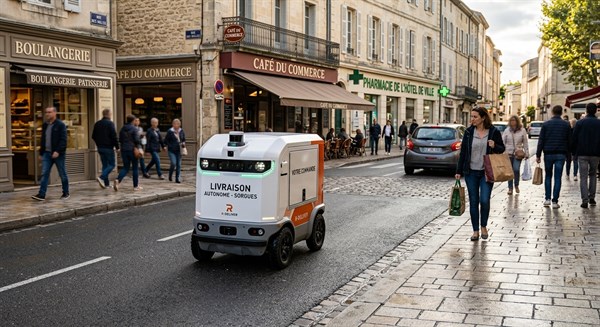
The delivery of packages in the heart of our cities is about to undergo a major technological shift. The government has officially taken the plunge by publishing a decree authorizing the approval of autonomous delivery robots designed to operate directly on the road. Until now confined to highly regulated experimental phases or limited to restricted areas, these driverless vehicles now have their own legal status. This decision positions France among the pioneering nations in terms of regulations for this type of vehicle.
The underlying economic and environmental stakes are enormous. The final link in the distribution chain, commonly known as the last mile, alone accounts for more than 30% to 40% of total shipping costs and generates approximately a quarter of greenhouse gas emissions in urban areas. With the continuous rise of e-commerce, city centers are facing chronic congestion and a proliferation of vans blocking traffic. The introduction of small, automated units aims precisely to alleviate these congested roads.
From a technical standpoint, these machines are no longer simply small sidewalk dumpers, but rather true intermediate-sized vehicles classified under category L (which includes motorized tricycles and quadricycles). Official regulations authorize large structures capable of reaching four meters in length, two meters in width, and two and a half meters in height, with a maximum payload of 1,000 kg. Powered by a 100% electric motor, these robots are equipped with an array of sensors, algorithms, and artificial intelligence, enabling them to travel several dozen kilometers autonomously while transporting a significant volume of goods.
Full autonomy does not mean a complete absence of control. To ensure the peaceful coexistence of these automated shuttles with motorists, cyclists, and pedestrians, the legal framework mandates a rigorous real-time remote monitoring system. A human operator remains available to intervene remotely at any time should a critical situation arise. Furthermore, this regulatory flexibility is accompanied by strict cybersecurity and privacy protection requirements, guaranteeing that the processing of data collected on the street complies with applicable standards.
The integration of these autonomous quadricycles is part of the overall reorganization of metropolitan logistics infrastructure. Combined with urban micro-hubs or local warehouses, these robots will perform regular, silent shuttles, significantly reducing noise and air pollution while meeting the requirements of Low Emission Zones. While their large-scale deployment still requires municipal approval and adaptation of the local road network, this regulatory advancement marks the beginning of a new era for urban goods distribution.