

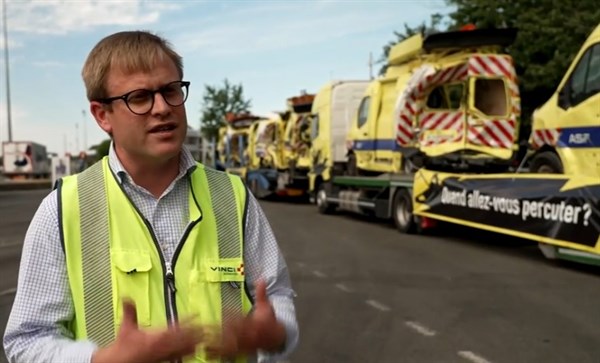
Every week on French highways, the same tragic scenario unfolds amid near-total indifference. Men and women in yellow vests, there to secure a lane or assist a stranded motorist, narrowly escape death because a driver has taken their eyes off the road. Faced with this surge in avoidable accidents, a radical shift in awareness has become essential. The figures speak for themselves: the rate of collisions with emergency vehicles shows no sign of slowing, transforming work zones and breakdown areas into veritable death traps for highway workers.
To make a powerful impact at the start of the summer holiday traffic, a macabre but necessary display was staged on the country's busiest highways. Strategic tollbooths, from Saint-Arnoult-en-Yvelines to Lançon-de-Provence via Vienne, were transformed into graveyards of mangled metal. By directly displaying some twenty heavily damaged emergency vehicles to holidaymakers, authorities and road operators cut through the abstract rhetoric. The objective was clear: to create a visual shock, forcing motorists to confront the consequences of their inattention.
This initiative, supported by the government and road safety authorities, targets a specific yet largely ignored behavior: failure to respect the safety corridor. Although this rule has been enshrined in the Highway Code for several years, requiring drivers to move as far away as possible or change lanes when approaching an orange or yellow vehicle, an overwhelming majority of French people still admit to being unaware of it or not following it. Digital campaigns, particularly through poignant videos shared on social media, attempt to address this lack of civic awareness by giving a face to these officers who are too often invisible behind their flashing lights.
The most striking aspect of these road statistics remains the typical accident profile. Almost all collisions occur in broad daylight, on perfectly straight roads, and in clear weather, when flashing lights and patrol car sirens are visible from hundreds of meters away. It's not the weather conditions that kill, but the lure of the asphalt, smartphone use while driving, and drowsiness. By moving these truck carcasses along holiday routes, road safety officials hope to spark a renewed sense of responsibility so that the journey to vacation doesn't become the final trip of a public service worker.